World Health Organization (WHO) PICC Line Guideline Development
The intended audience for these guidelines are clinicians (that is, doctors, nurses, IPC professionals, etc.) involved in the management of patients who require intravascular catheters. However, to ensure an appropriate, practical, clinical adherence to the guidelines, hospital administrators and other professionals involved in health care need to understand their importance and the focus of the recommendations to ensure appropriate support for clinicians. Patients are also part of the audience of these guidelines as they need to be generally informed about practices performed for their care and, in some cases, understand the choice of the intervention(s).
Click here to see: WHO Guidelines for the prevention of BSIs associated with intravenous catheters
Bloodstream Infections associated with intravenous catheters are frequently seen and are easily prevented through safe clinical practices, educational tools and guides, and applying proper insertion techniques. Bacteria can enter a PICC line if a dressing change is done improperly or not changed, can enter through the crack of a PICC line causing sepsis, and improper hand hygiene when handling the PICC line (especially during insertion procedure).
The Following Are Important Facts Founded by the World Health Organization:
- Mostly preventable if appropriate insertion, maintenance, access and removal protocols are followed for IV catheters. The overall clinical results of systematic reviews calculated that implementing Infection Prevention Controls (IPC) can achieve a significant reduction of Healthcare-associated infection (HAI) rates, in particular catheter-associated BSI (CABSI), irrespective of a country’s income level
- Can be caused by antimicrobial-resistant pathogens and thus difficult to treat. BSIs due to a range of resistant pathogens, mostly associated with health care, were found to be the second most frequent cause of the global burden attributable to and associated with AMR in 2019, causing almost 1.3 million deaths around the world
- In Europe, health care-associated BSIs are the second most common cause of disability and premature deaths due to HAIs. The crude excess mortality due to catheter-related BSIs (CRBSI) in adult patients was 23.6% in a study conducted in 25 countries worldwide
- Ability to evolve into serious, deep-seated infectious complications to major organs such as the brain and kidneys, including bacterial endocarditis, lung abscesses and infectious embolic events. These complications are often associated with clinical sepsis and septic shock. WHO estimated that mortality among patients affected by health care-associated sepsis was 24.4%,increasing to 52.3% among patients treated in an intensive care unit
- Up to 70% of all inpatients requiring a peripherally intravenous central catheter (PIVC) at some time during their in-hospital stay. Thus, the global burden of BSIs and other related infections associated with PIVCs is potentially huge. However, health care-associated BSIs have also become increasingly associated Introduction with the use of peripherally-inserted central venous catheters (PICCs)
Proper PICC Line Insertion Techniques
- PICC line insertion nurse must determine appropriate catheter length by using measuring tape to measure from the point of venipuncture, over the course of the selected venous pathway, across the shoulder to the right side of the sternal notch, and down to the third intercostal space
- Disinfect the catheter site with 2% of chlorhexidine gluconate ethanol solution
- Don personal protective equipment (PPE) prior to insertion technique. This includes gown, gloves, masks and patient must be covered using sterile sheets.
- Vascular ultrasound guidance combined with the modified Seldinger technique should be used to insert PICC line catheter, preferably the right upper arm which leads to improved puncture and successful catheterization rates and reduced complications
- Optimal position for the catheter tip is from the lower third of the superior vena cava to cavoatrial junction; however, the catheter tip should not enter the right atrium. This can be verified via chest X-ray imaging.
Any issues or worries should be communicated with your healthcare team. If you experience any chest pain or breathing complications, call 911 immediately
PICC line Placement Diagram
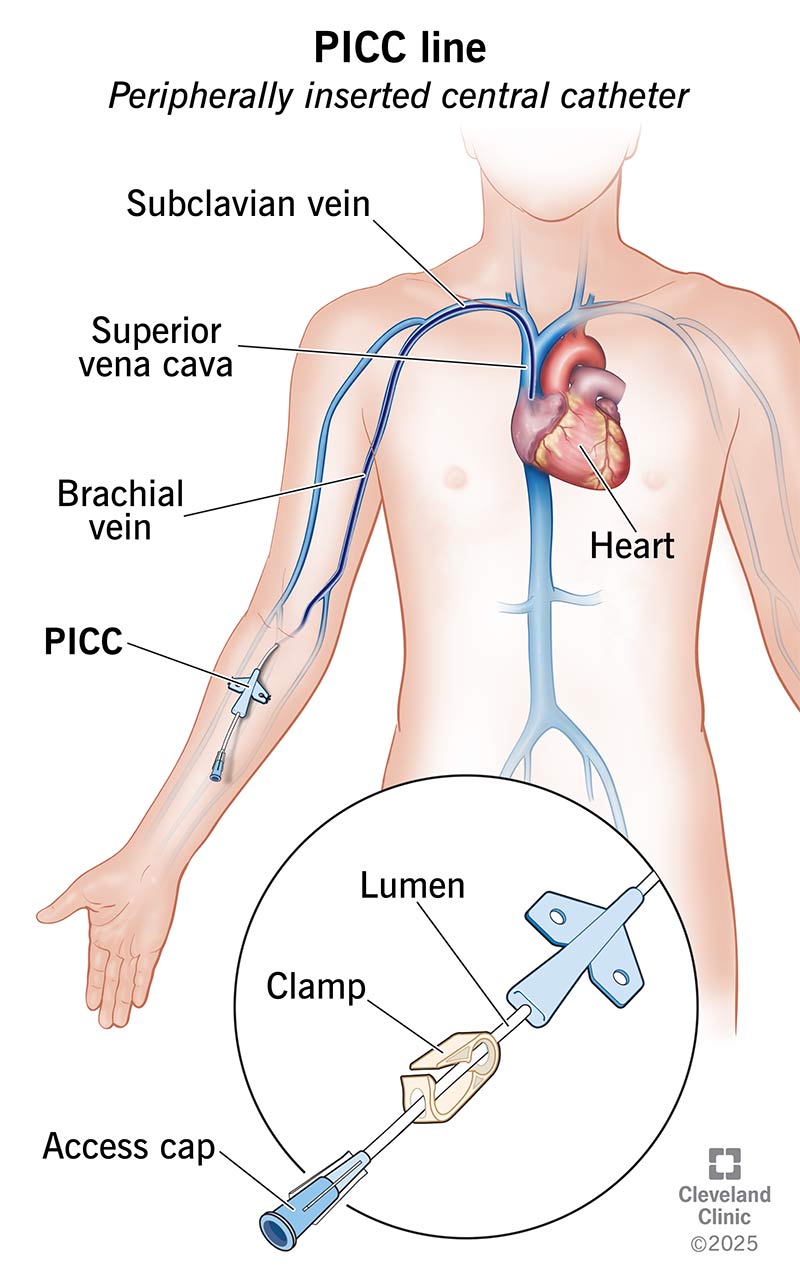
Peripherally Inserted Central Catheter
- Long, thin tube inserted into a vein in the upper arm guided to larger vein near the heart (super vena cava)
- How is it used?
- delivers long-term IV of chemotherapy, antibiotics, liquid nutrition and blood products
- medical personnel can draw blood from the line reducing frequent needle sticks
- good for patients who need long-term usage (up to 6 months)
Brachial Vein
- Carries deoxygenated blood from the forearm back to the heart
Superior Vena Cava
- Collects deoxygenated blood from the upper body (head, neck, arms) directly to the right atrium which is located in the heart
Subclavian Vein
- subclavian vein is a deep vein that moves oxygen-poor blood from the upper body back to the heart
Access cap
- An injection cap or port protector, creates a sealed system that prevents air, bacteria and other environmental contaminants from entering the bloodstream
Lumen and Clamp
- Lumen: The internal channel or pathway within the central tubing
- Clamp: Plastic external clamp at the end of the lumen to prevent air and control the flow of fluid through the lumen. The clamp must be closed when to in use to prevent blood from flowing back through the channel.
Leave a Reply